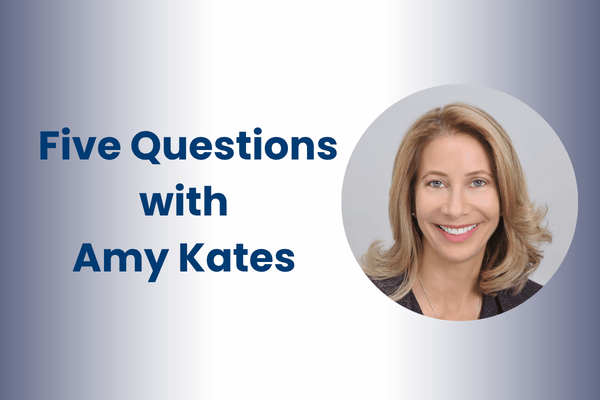
Amy Kates is an organization designer, author, and advisor to business leaders around the world. She co-founded Kates Kesler Organization Consulting, which was acquired by Accenture in 2020. There she helped build the 150-person Organization Design and Operating Model global practice. She has served as a Visiting Fellow to the Government of Singapore and is currently on the board of Educate!, the largest education non-profit in east Africa. She is the co-author of seven books. The most recent, with Greg Kesler, is “The Organization Design Practitioner: Designing Operating Models to Deliver” (Wiley, October 2026).
We asked Amy what’s changing, what endures, and where leaders should look to accelerate both performance and culture gains.
Q1: Operating Models, Reimagined: How are you currently thinking about the future of operating models and organization design — and what enterprises, large or small, should be paying attention to right now?
Here is the question I am frequently asked by leaders: As we go through another profound technological shift, this time agentic AI, is it even possible to shape systems that are being influenced by forces we don’t yet understand?
Yet it is exactly the continual change and uncertainty in the external environment that makes being intentional about the internal workings of the organization more important than ever. Beyond new technologies, there are trade wars and tariffs, demographic shifts, and environmental change. Effectiveness and advantage come from the ability of all members of the organization to anticipate and make sense of these changes together.
While the business, global, and technological context changes ever more quickly, human beings fundamentally don’t. Our desire to work in small collaborative groups, to depend upon trust as much as contracts, to compete against others, and to need goals and purpose in our work is hard-wired in. While individuals are unique, humans in large groups are actually quite predictable.
Here’s what we believe won’t be replaced by AI: the need for organizational leaders to create shared meaning from themes and patterns, understand the trade-offs across equally attractive alternatives with different implications, and make hard choices. Therefore, the work of leaders becomes even more important in times of change. Leaders set long-term goals and then make the continuous and often unexpected trade-offs between strategic options in the short term. No company planned for Covid. But the companies that quickly made decisions and mobilized their organizations around new ways of working and customer interactions turned the pandemic into an opportunity. Translating the external context into strategy and then organization realities is the uniquely human work of leaders. This won’t change. Good decision-making can be augmented by better data and AI insights, but taking the bet and making the change is still human work.
Q2: Lessons Learned: Looking back on your 30-year career in organization design, what’s one lesson you wish you knew at the start—and why?
The lesson is that credibility – as any sort of consultant or advisor – is earned by sharing insights and good judgment, not just expertise. One can be a brilliant diagnostician and still fail at organization design if one’s insights aren’t delivered in a way that the client audience can hear and accept them. This is particularly true when working with executives. Their time and attention are limited, they’ve worked with many consultants, and they are often skeptical and weary of endless decks full of frameworks and charts.
Designers who succeed know how to ask questions that make people think differently. They surface conflict without making it personal. They know when to push and when to let a leadership team work through something themselves. I had to learn that my client wants to work with me because I make hard conversations easier, not harder.
Organization design isn’t about handing down expert answers. The job is to guide a leadership team to discover the right solution for their context. That means being comfortable with ambiguity and seeing where the data leads. It means artfully managing group dynamics. And knowing that sometimes the best thing you can do is ask one more clarifying question instead of jumping to recommendations. This kind of judgment cannot be fully codified. It is developed through exposure, reflection, and pattern recognition across many client contexts. New organization consultants often underestimate how much clients assess how you intervene, not just what you recommend. It took me a long time to learn this. As I am coaching the next generation of organization designers, I spend as much time on this as models and frameworks.
Q3: A Global Bright Spot: What’s one global trend that gives you real optimism about the future of organization design, and why?
One trend that gives me real optimism is the move toward more horizontal and networked organizations. Hierarchy is still important to create differentiated focus across different time horizons. But advances in data visibility and collaboration tools mean companies can now reconfigure teams around outcomes in near real time.
Over the past 30 years I’ve seen an increasing sophistication in how corporate and private equity leaders think about organization. There’s a clear shift from viewing org design as a cost exercise to seeing it as a core lever of value creation. The skills of the profession and the client have evolved together, and now the conversation is less about org charts and more about decision rights, information flows, and governance.
Q4: A Favorite Impact Story: What’s a favorite example where you helped an organization—private, nonprofit, or public sector—rethink strategy, structure, and talent in a way that led to remarkable results?
I have worked with many remarkable organizations over the years, and I do believe that good organization design makes a difference in both business results and the quality of the work environment for individuals. But it is hard to establish causality. We have typically worked with sophisticated and forward-thinking leaders who see the connection between strategy, organization, and talent. Our work is usually just a piece of a larger change.
One of the most interesting engagements was with the Government of Singapore. Over two years I both trained their internal consultants and worked directly with a number of agencies. Governments at all levels are typically set up by departments that haven’t changed for decades – education, housing, utilities and energy, transportation, health, etc. But the problems to solve are cross-agency, for example, climate change, economic opportunity, or an aging population.
Singapore had high level working groups for these types of issues but lacked robust mechanisms for the agency staff to really collaborate on solutions. We were able to bring them a toolbox of integration mechanisms that allowed them to change how work got done. Just as with the private sector, the process is the same. Start with the problem to solve, understand the work, and then build organizations that make it easy for people to work across boundaries.
Q5: The Lighter Side: What’s a fun fact about you—or a favorite book or trip?
Through my involvement with Educate! I have had the opportunity to spend time in East Africa over the past 10 years. One of my favorite places there is Ishobe, a farm-stay and wellness retreat in Rwanda, just north of the Kigali capital. Chantal Umuraza, the owner, has built it in the style of a what would be a B-Corp in the US. The proceeds fund the surrounding community. It was built and is staffed by locals.
For the visitor it is quite a magical experience to be immersed in the rhythms of a working farm and experience contemporary Rwandan culture and food, all while relaxing in comfort in the tropical beauty of the Rwanda hills. And it is well located for those coming to see the gorillas or go on safari. I have played a small part in developing it over the years, and I am most excited to see this new type of tourism take hold, which is quite different than the lodges that have traditionally catered to tourists. My visits are always a highlight of my year.
At Mann Partners, we believe great organization design turns strategy into performance—especially in times of change. Huge thanks to Amy for sharing her perspective and insight.